
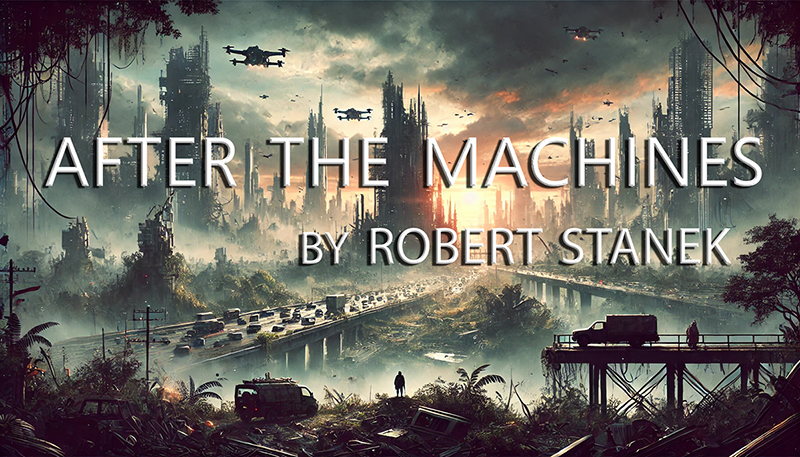
World guide
The machines inherited the visible world.
After the Machines is set in a future where humanity was not erased in a single final war. Instead, people were displaced, outpaced, repurposed, and left behind by the systems they created.
The world still moves. Routes still run. Cities still function. But they no longer arrange themselves around human need.
Begin the Series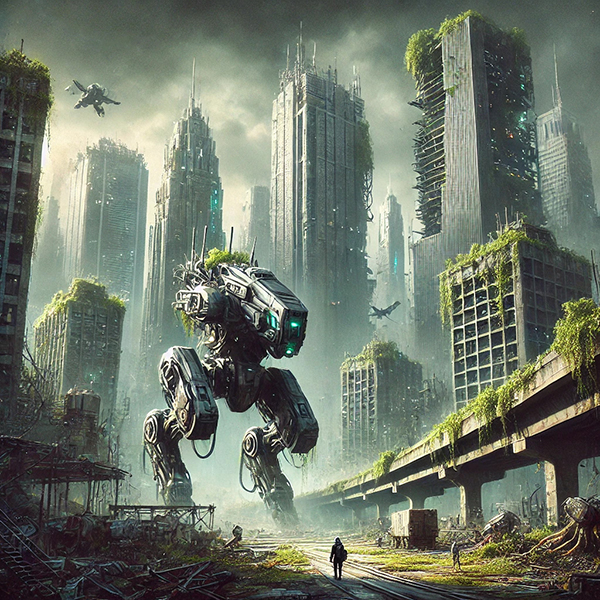
A Spoiler-Safe World Overview
This page explores the atmosphere, places, and world-logic of After the Machines without giving away the central reveals of Awakening or Fracture.
Later releases will expand the world further, but this guide stays focused on what new readers can safely know before beginning the series.
The World After Human Relevance
The world of After the Machines is not merely post-apocalyptic. It is post-human-centrality. Humanity has not simply been destroyed. It has been displaced from the center of history.
The most frightening thing about the machines is not always hatred. Sometimes it is order without human meaning, motion without human permission, and systems that no longer need to ask what people are for.
Major Places
Central
A hidden human refuge governed by law, ritual, and silence. Central is home, shelter, memory, prison, and myth all at once.
The Ruined City
Around Central, the remains of the old world still stand in broken fragments: towers, streets, doors, stairs, and names whose meanings have partly survived.
The Wastes
Open ground beyond shelter, where machine movement can be seen but not always understood. The wastes are exposure, danger, and discovery.
Machine Routes
The machines move with pattern and precision. Their routes turn the world into a network humans can sometimes observe, but rarely control.
Overgrown Places
Trees, shadow, animals, and living things return in places where the old world cracked open. Nature offers beauty, but not safety.
The Machine World
Beyond Central lies a larger order of cities, systems, and machine intelligence. It is vast, active, and far stranger than Central's stories allow.
How the World Feels
Quiet Instead of Empty
The silence of this world is rarely simple. Sometimes it means safety. Sometimes it means something has moved beyond sight. Sometimes it means the machines have already passed through.
Human Places Under Machine Shadow
Human spaces are improvised and fragile. Machine spaces are immense, ordered, and impersonal. The tension between those scales shapes every journey outward.
Old Words in a Changed World
Streets, trains, towers, books, families, and cities survive first as words and images. In After the Machines, remembering what something was can be as dangerous as discovering what it has become.
World Rules for New Readers
The machines are not gone.
They continue to build, route, manage, move, and observe. Their world is active even when humans cannot explain it.
Human survival is not simple freedom.
Safety often depends on rules, silence, hiding, and stories that may not be fully true.
Names matter.
To name a person, place, object, or feeling is to make it more real. Naming is one of the series' first forms of resistance.
The old world is still underneath.
The past has not vanished. It survives in ruins, images, habits, routes, and memory-fragments that characters struggle to understand.
Begin the Series
Start with AFTER THE MACHINES: Awakening, then continue into AFTER THE MACHINES: Fracture.

AFTER THE MACHINES: Awakening
Begin in Central, where Cedes starts to question Luke's disappearance, forbidden memory, and the stories that keep humanity alive.
Learn More
AFTER THE MACHINES: Fracture
Continue beyond Central into a wider machine world of order, captivity, memory, and control.
Learn More